A game of games for every kid

The Honorable Path Washington's Life

A history and vocabulary campaign for kids 6 to 12. General Washington leads the way as a patient, fatherly mentor, from his boyhood copybook to the Revolution.

Join the free beta (Windows & Mac)

  • Works offline
  • No ads
  • No accounts
  • No data collected
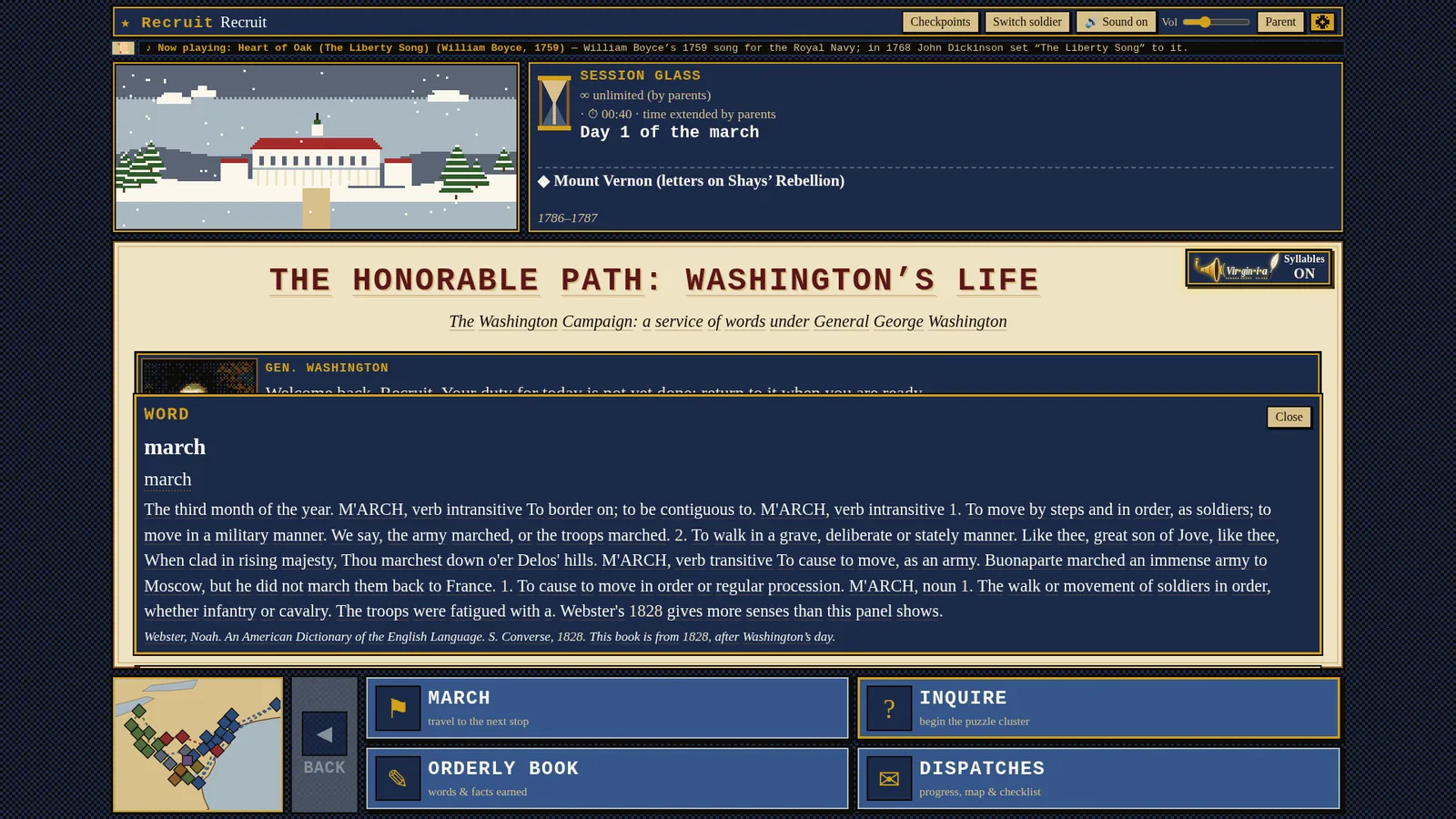
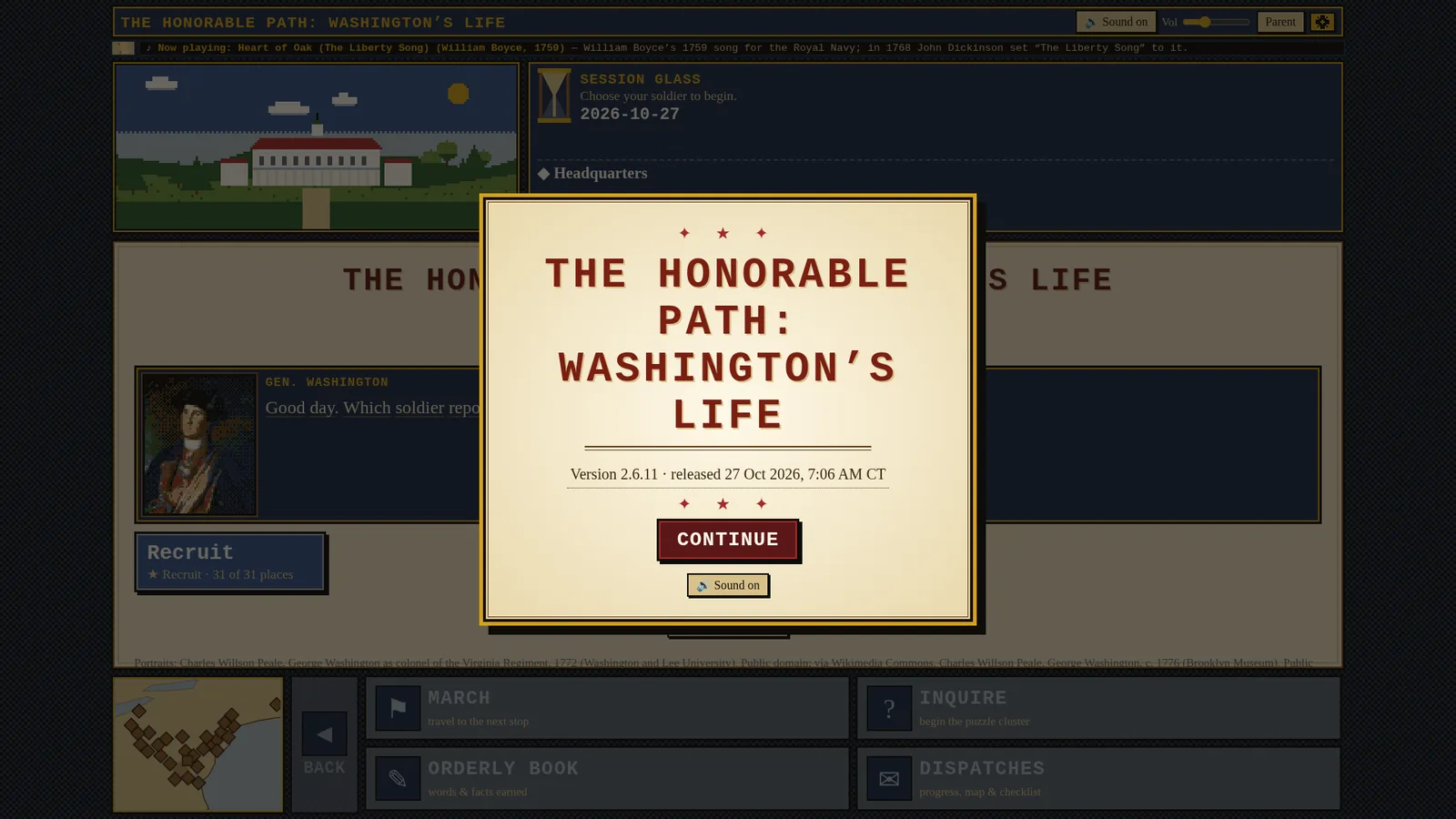
Title card for The Honorable Path: Washington's Life, version 2.6.11, over the Recruit roll.
Version 2.6.11. Each child picks a soldier and carries on where they left off.

For the whole family

Made to play together

Older siblings help, younger ones stretch, the whole family learns.

I made The Honorable Path for families, not just one child. It comes from my own home. When my kids play, an older sibling often sits alongside and helps the younger one read the words and make the choices. The older one learns to teach, the younger one stretches, and they have a blast together.

— Matthew

  • Older kids learn by teaching

    Explaining a word or a choice to a little brother or sister makes it stick for the big kid, too.

  • Younger readers grow with help

    It's made for ages 6 to 12. With a big sibling beside them and syllable help on, younger readers reach a little higher.

  • Parents can join in, too

    Pull up a chair, read a page aloud, or take a turn at a mini-game. Learning side by side is half the fun.

Our story

Why I Made The Honorable Path

My son has always loved it when I read to him. Snuggled up with a good story, he'd hang on every word. But when it was his turn to read, everything changed. He didn't want to, and getting him to try felt like pushing a wagon uphill.

So I tried something different. I built him a game: a text adventure where the only way forward was to read. Almost overnight, he was excited about reading. The words weren't a chore anymore. They were the path to the next adventure.

Then it hit me. If a game could make him want to read, it could do much more. I could build in the vocabulary I wanted him to learn. I could have him memorize the documents that shaped our founders. And really, I could gamify almost anything I wanted him to learn.

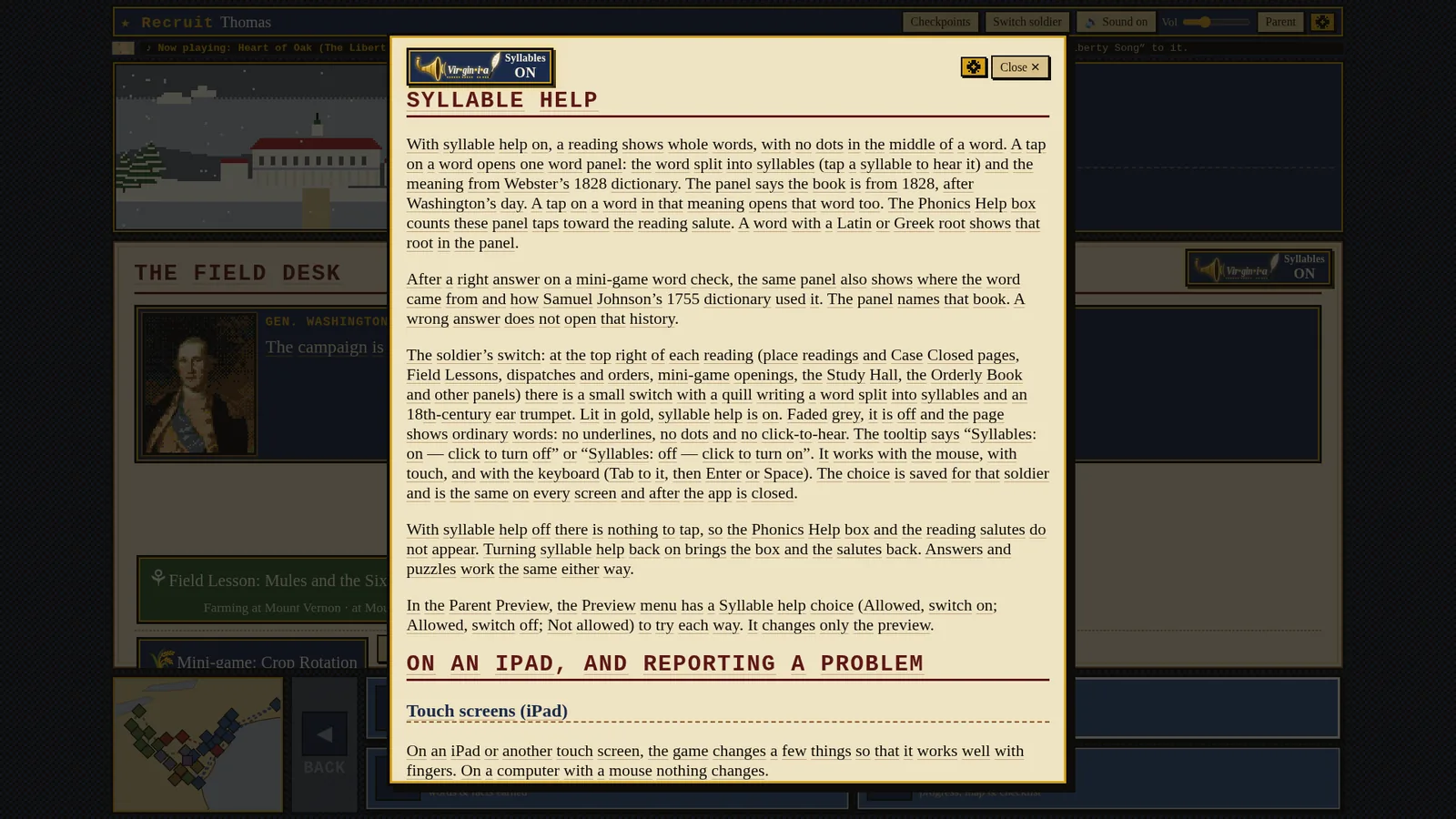
I've never liked teaching reading by sight alone. Kids deserve to know how words work. So I built a syllable mode. When a child taps a word, the game breaks it apart and sounds it out one syllable at a time in a cheerful 8-bit voice, then says the whole word. Seeing the word split up while hearing it split up makes it click fast. My son loves it, and he earns bonuses for reading without help, all the way up to a 21-gun salute.

Underneath it all, I wanted to pass on something bigger: the history and values of our country's founding. As a boy, George Washington copied out the Rules of Civility by hand, and he spent the rest of his life trying to live by them. Following him from that copybook through surveying, a voyage to Barbados, the French and Indian War and the Revolution shows kids what duty, honor and civility look like in a real life.

Along the way they learn the Latin and Greek roots behind hundreds of English words. They read Washington's own journals and letters, with real citations. They work through math and science in 15+ mini-games set in his world, from sailing by dead reckoning to rotating crops to cracking a spy cipher. And they hear fife tunes and drum calls from Washington's time while they play.

It's made for kids 6 to 12. The younger ones will have to stretch, and that's the point. With a parent beside them and syllable help switched on, they grow into it. Parents get separate profiles for each child, printable report cards and control over how much help each child gets.

It runs offline, with no ads, no accounts and no data collected. It's just a father's attempt to give his son a love of reading, a love of learning and an honorable path to follow. I hope it does the same for your family.

— Matthew Nowlin
What kids learn

Each stop on the campaign mixes reading, words and a little history. It covers many subjects at once, which is why we call it a game of games.

Vocabulary

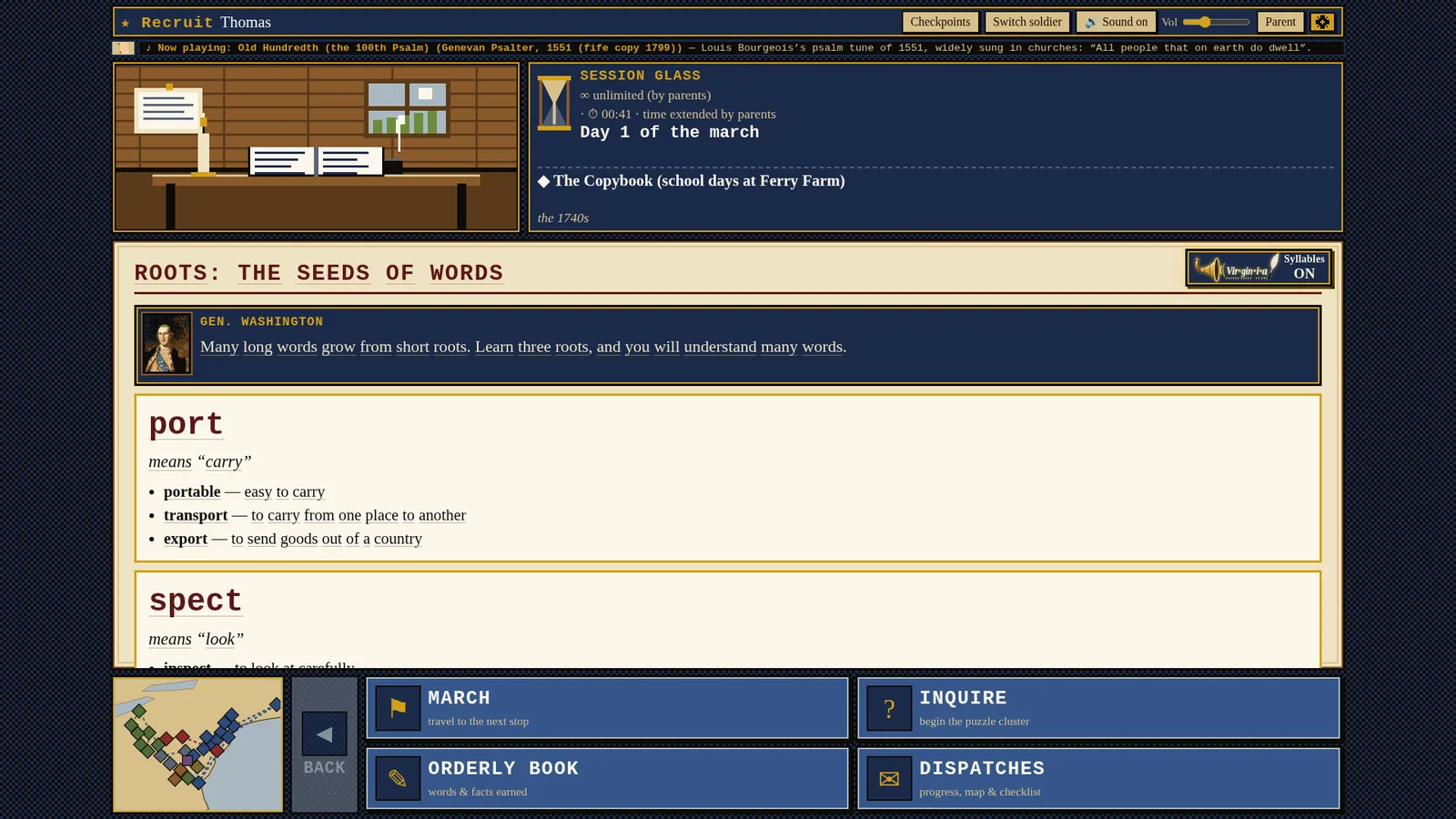
Latin and Greek roots

Kids learn root words and their families, then spell words and define them in context.

port · spect · scrib · dict · struct · fort · liber …

Phonics

Help when they need it

Optional syllable help lets a child tap a syllable to hear it. Parents turn it on per child. Reading without taps earns a bigger bonus, up to a 21-gun salute.

Reading

Primary sources

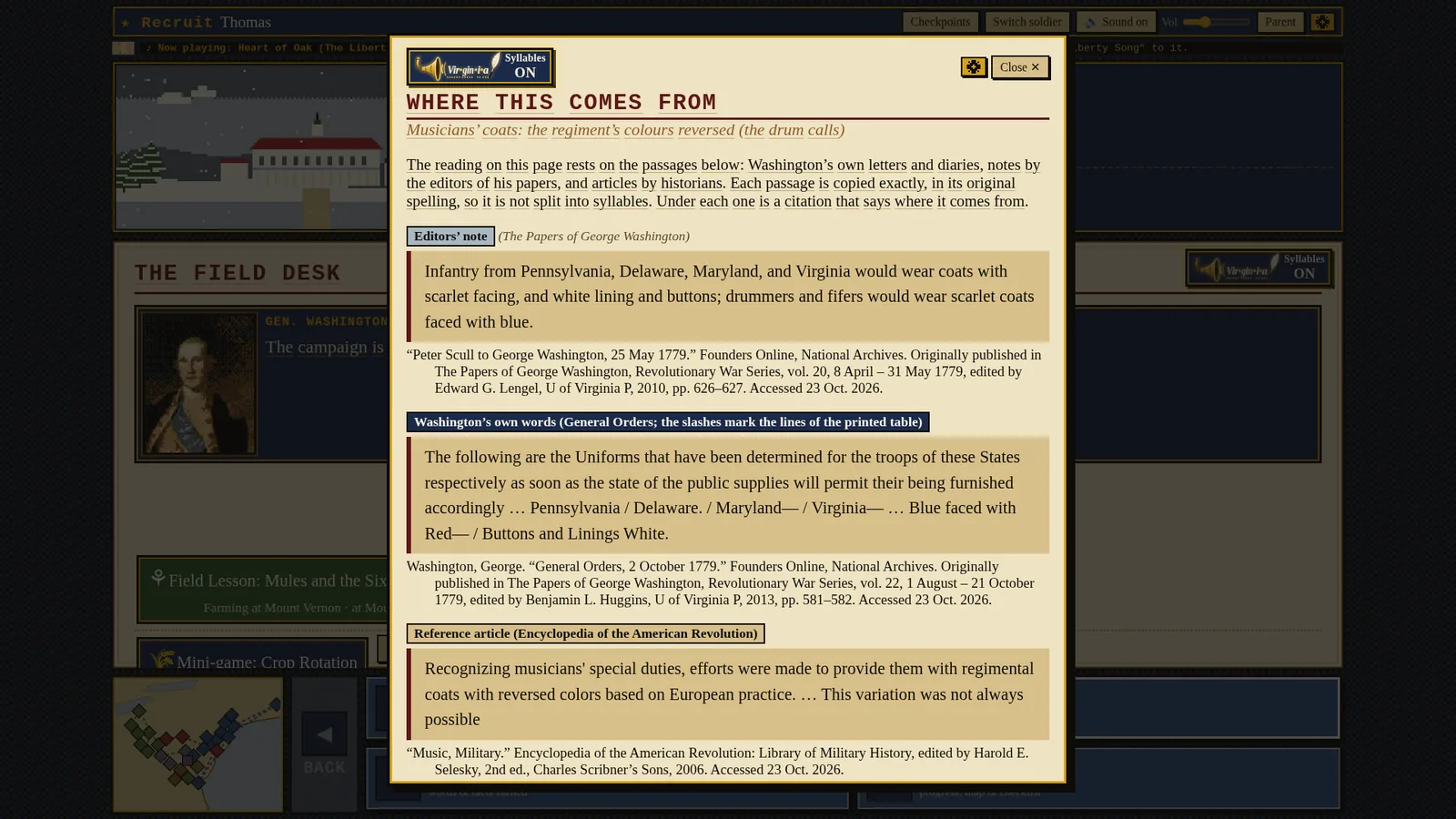
Every reading has a ? box. It shows the quoted source passages behind the page, each with an MLA citation.

Character

Duty, honor, civility

Young George copies the Rules of Civility, which came from a 16th-century French Jesuit list. Those ideas follow him through the whole story.

Math and science

15+ mini-games, set in history

Sailing by dead reckoning, crop rotation, a ledger in pounds, shillings and pence, and more. Each one sits where it belongs in Washington's life.

Music

Fife and drum

Fife tunes and drum calls from Washington's time, played with real instrument sounds. There is a mute button.

About 31 history readings, in order

  1. BoyhoodCopying the Rules of Civility
  2. SurveyingMeasuring land as a young man
  3. 1751The voyage to Barbados
  4. FrontierThe French and Indian War
  5. RevolutionLeading the Continental Army

How it plays

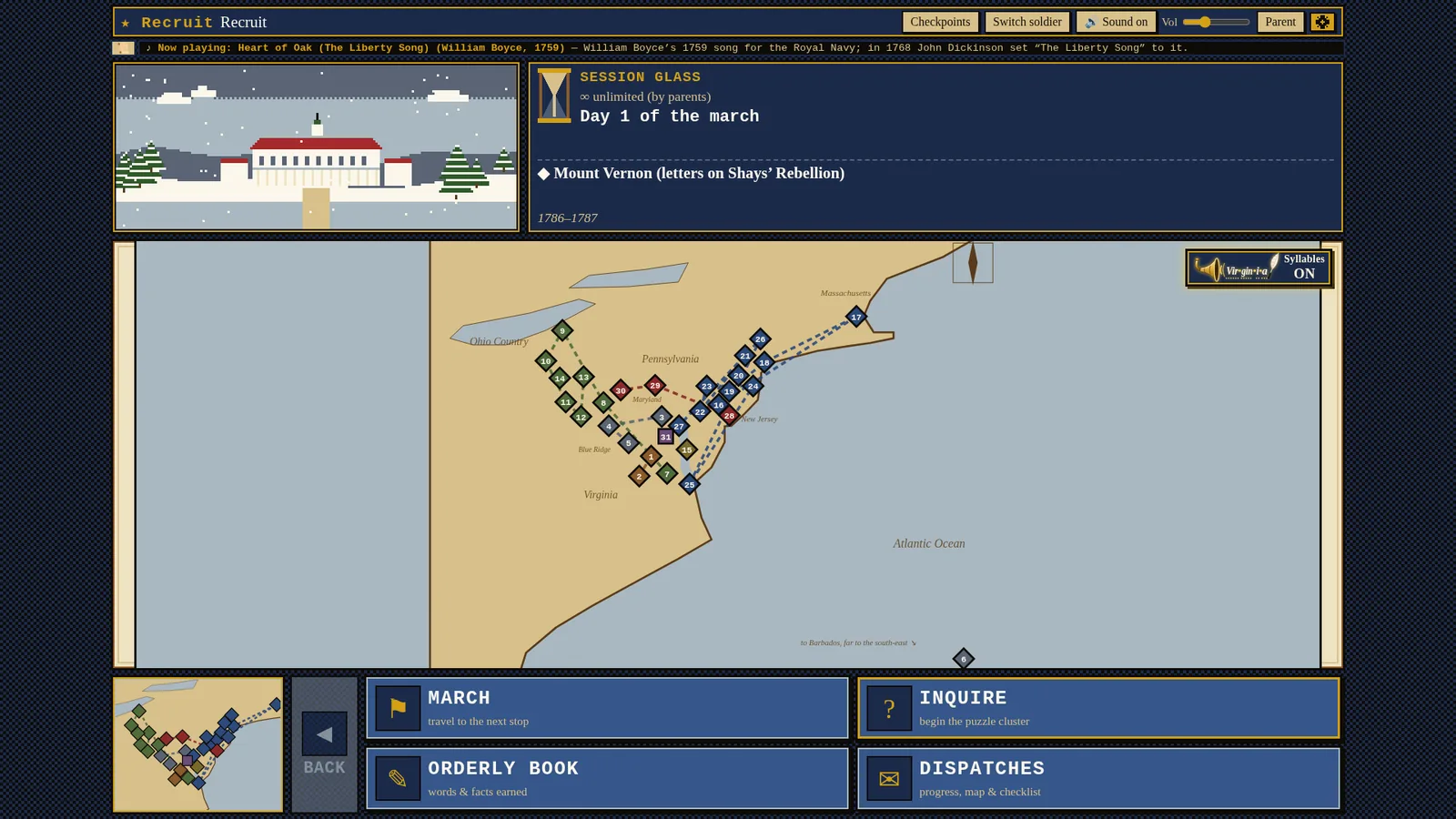
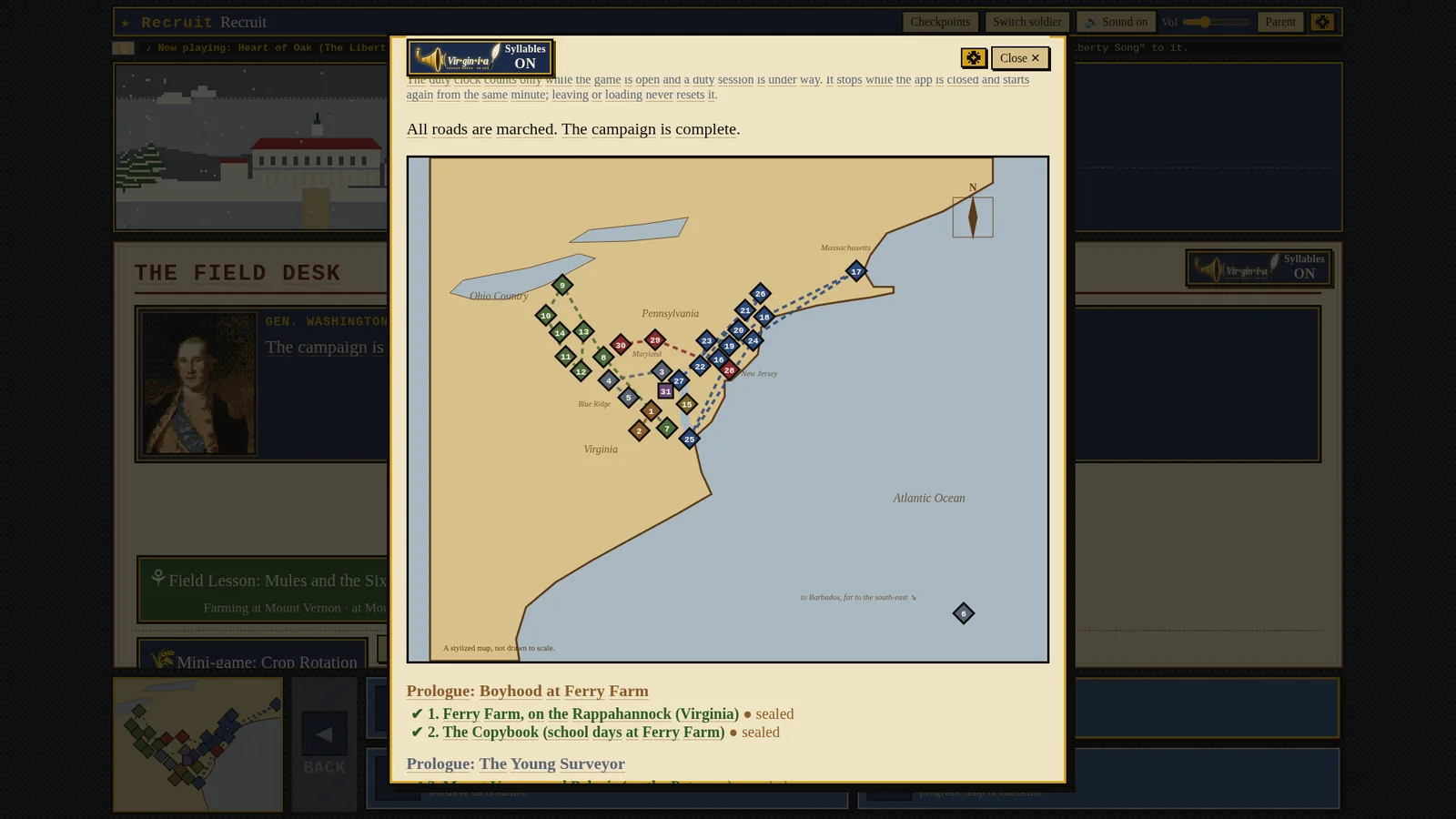
Travel from place to place, gather clues, and earn your way forward. Here the case is a life: George Washington's.

  1. March

    Pick the next stop on the map of Washington's world.

  2. Read

    Read a short history page and a dispatch from the General.

  3. Inquire

    Solve word puzzles built on roots, spelling and meaning.

  4. Play

    Try the mini-game for that place, then march on.

The mini-games

Each mini-game sits at a real moment in Washington's life. Every one ends with the true history behind it and, where one exists, Washington's own words.

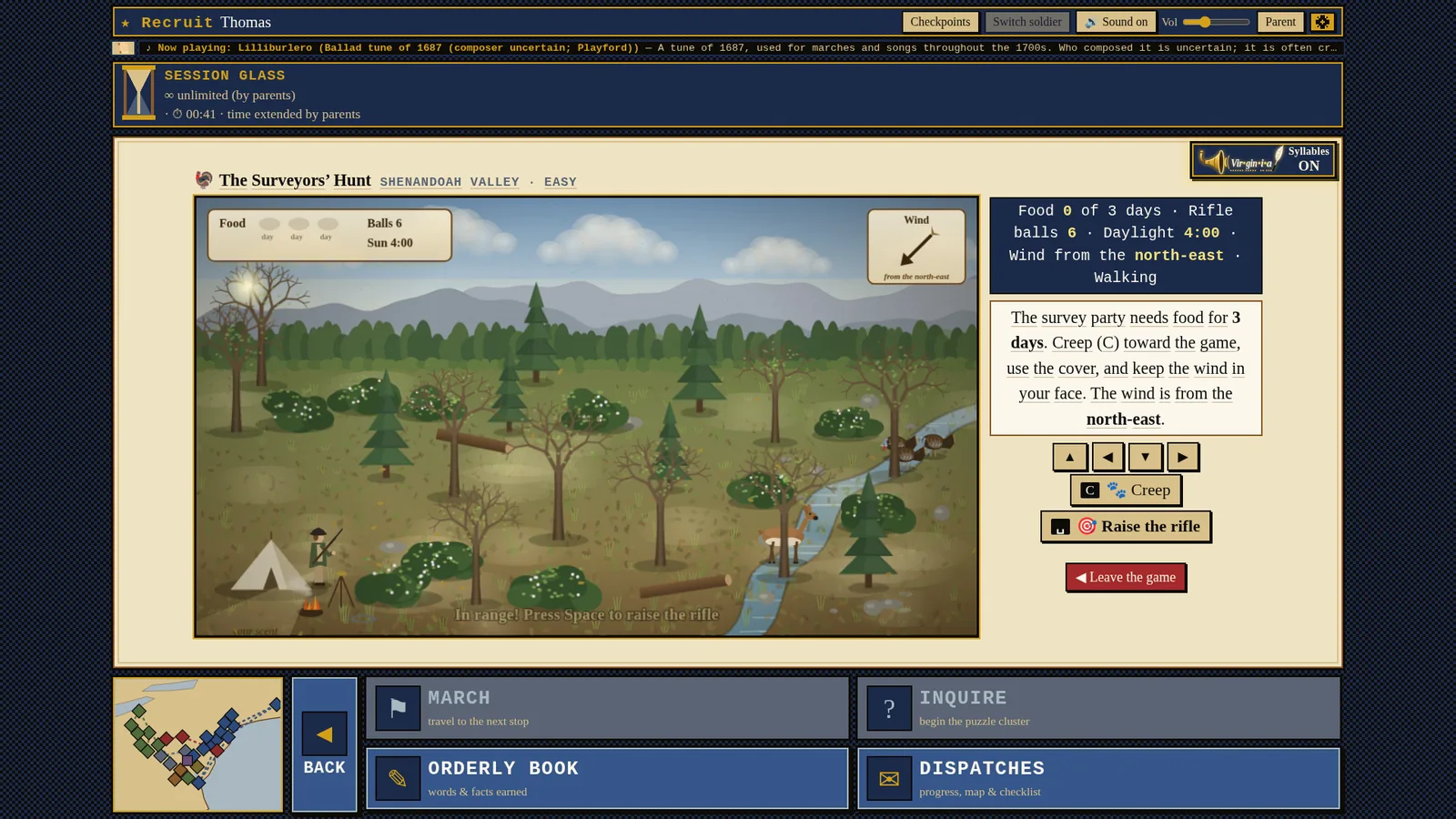
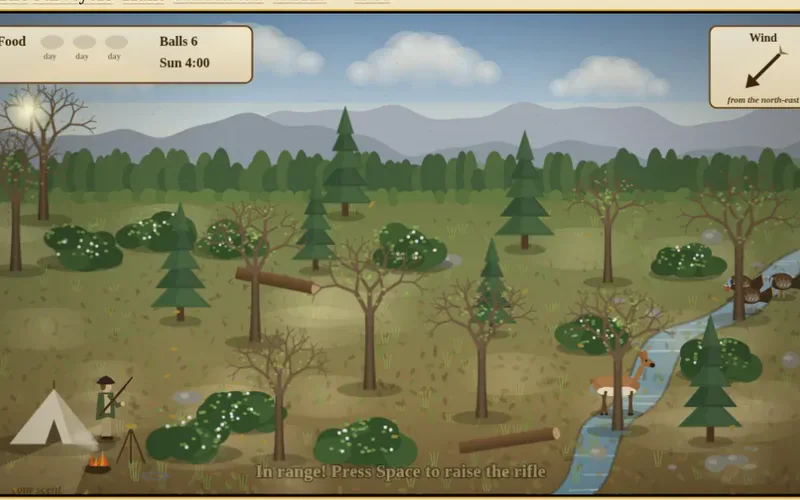
  • The Surveyors' Hunt, Shenandoah Valley. Deer stand in the woods, the surveyor has a rifle, and the line on the picture says “In range! Press Space to raise the rifle.” The wind is from the north-east. A tent and a small fire sit at the left edge.

    The Surveyors' Hunt

    Shenandoah Valley

    What it teaches: patience and timing (Easy, Medium or Hard aiming)

    The history: As a teenager, Washington spent weeks in the Virginia backcountry with surveying parties, and they hunted for their food.

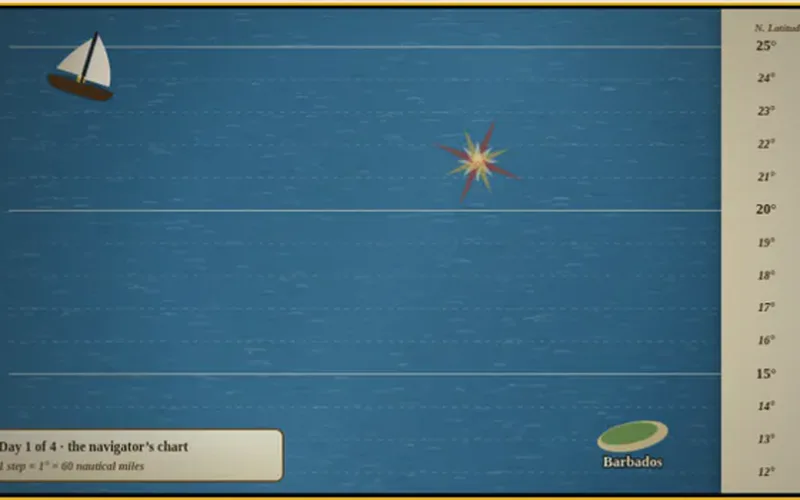
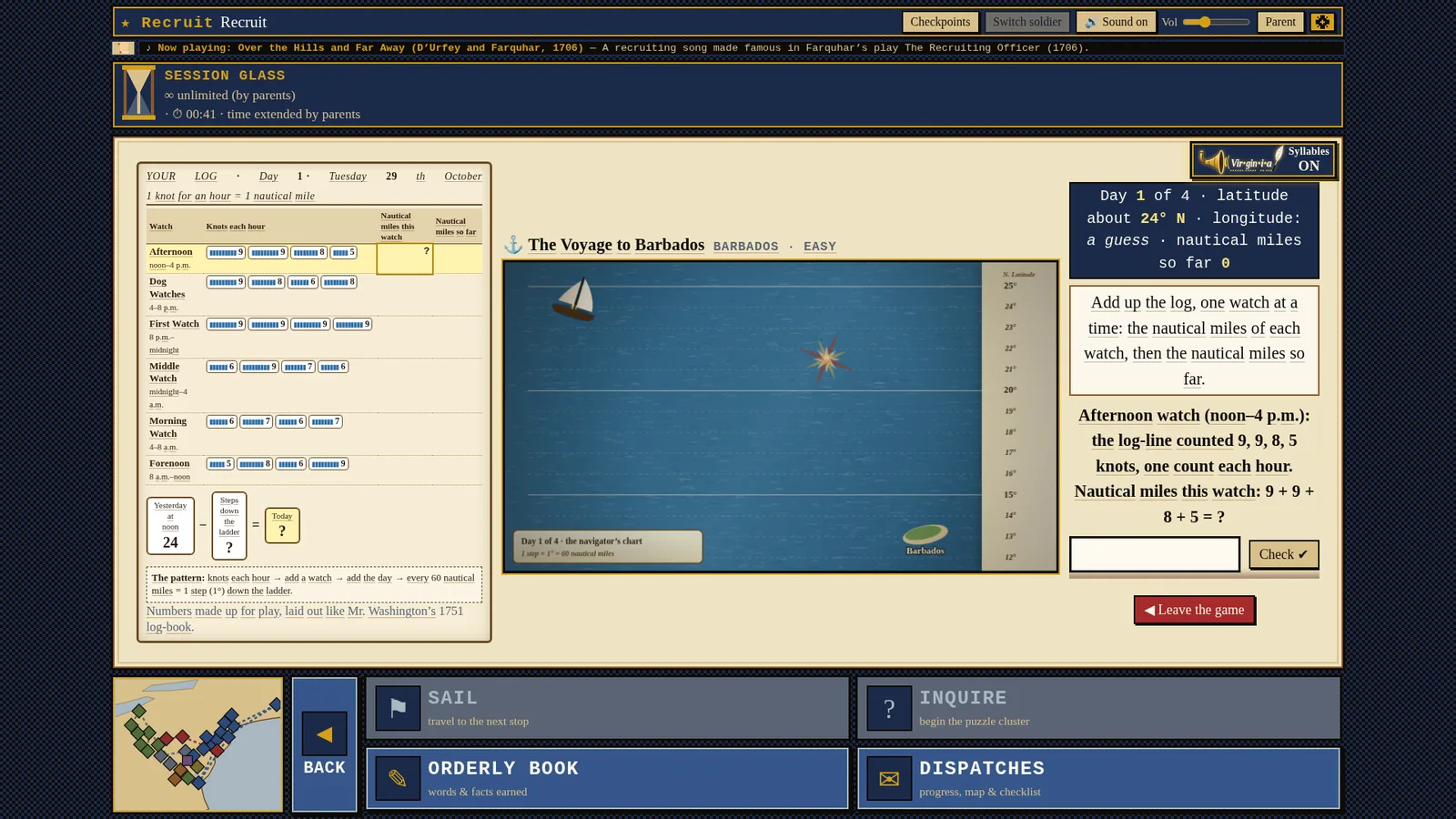
  • The Voyage to Barbados, day 1 of the navigator's log, Tuesday 29 October. The afternoon watch is on the page.

    The Voyage to Barbados

    At sea, 1751

    What it teaches: multiplying speed by time, reading a compass course, measuring an angle

    The history: In 1751 Washington sailed with his sick brother Lawrence and kept a daily log. Kids help the ship's master work out the ship's position from course and speed, measure speed with a knotted log-line, take the noon sun for latitude, and learn why nobody could measure longitude at sea yet.

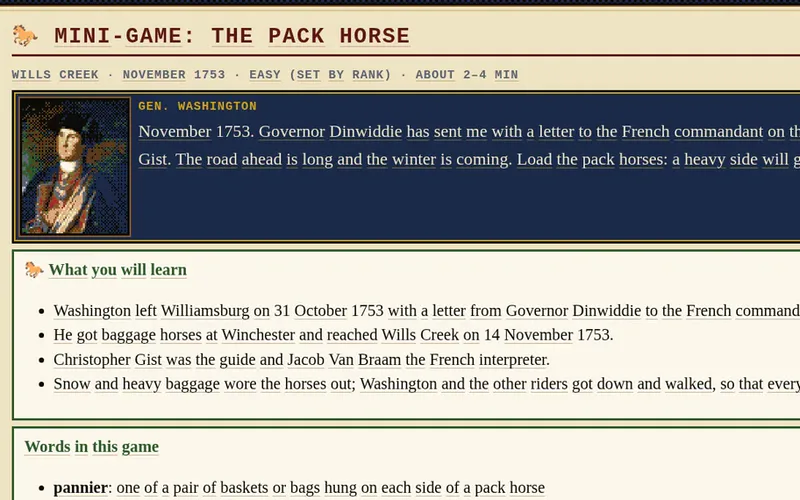
  • Mini-game card for The Pack Horse, Wills Creek, November 1753. Washington's orders to load the horses, and the words pannier and baggage.

    The Pack Horse

    Wills Creek

    What it teaches: weighing, balancing, deciding what matters most

    The history: In November 1753 Governor Dinwiddie sent 21-year-old Washington into the wilderness with a letter for the French. Kids balance the horse's baskets at Wills Creek, where guide Christopher Gist joined him.

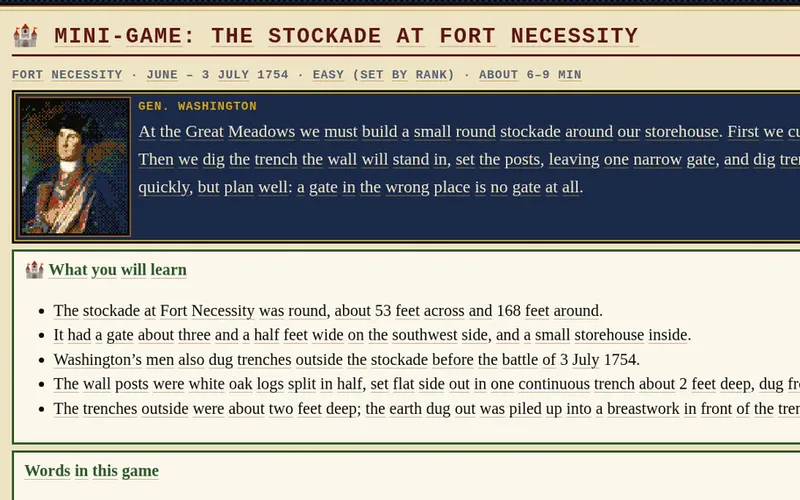
  • Mini-game card for The Stockade at Fort Necessity, June–3 July 1754, with the stockade lesson.

    The Stockade at Fort Necessity

    Great Meadows

    What it teaches: working around a circle, counting, planning time

    The history: Built to the real fort's size, about 53 feet across, as archaeologists confirmed. Washington's men built it in 1754 just before the French attacked.

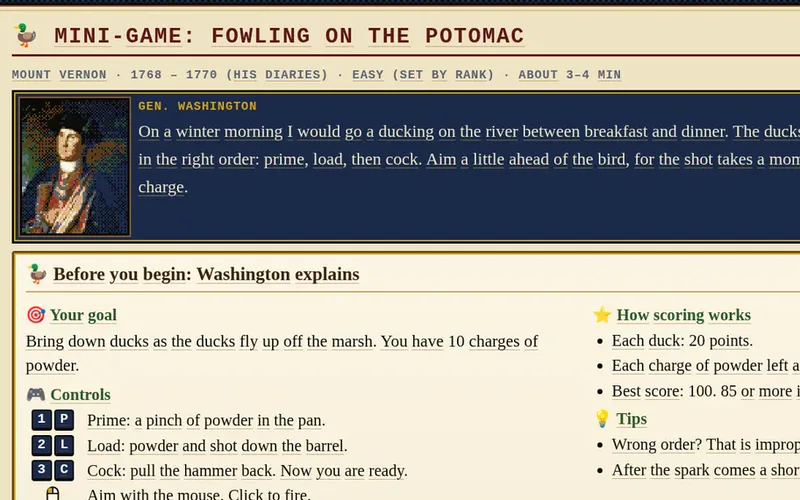
  • Mini-game card for Fowling on the Potomac, Mount Vernon, 1768–1770: prime, load, cock, then aim.

    Fowling on the Potomac

    Mount Vernon

    What it teaches: leading a moving target, timing

    The history: Kids shoot ducks on the river at Mount Vernon, the way Washington did at home.

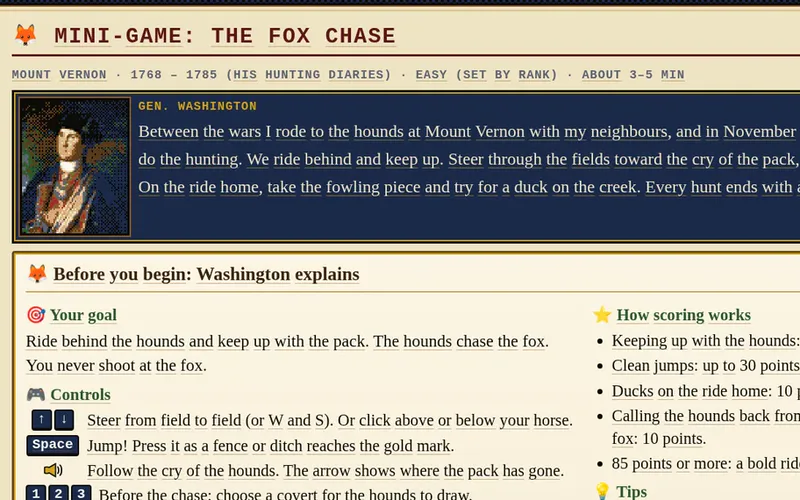
  • Mini-game card for The Fox Chase, Mount Vernon, 1768–1785: ride with the hounds, and do not shoot the fox.

    The Fox Chase

    Mount Vernon

    What it teaches: following a trail on a map, planning a route around obstacles

    The history: Washington's diaries record his fox hunts down to the minute, including six hunts with Lord Fairfax in 1768.

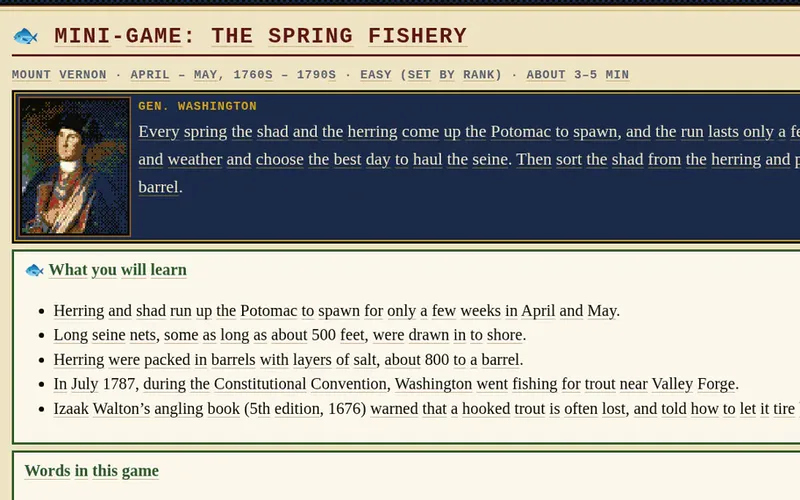
  • Mini-game card for The Spring Fishery, Mount Vernon, April–May, on the shad and herring run.

    The Spring Fishery

    Mount Vernon

    What it teaches: reading clues to make a choice, dividing large numbers, quick timing

    The history: Each spring Mount Vernon hauled huge nets of shad and herring from the Potomac and packed about 800 fish to a barrel.

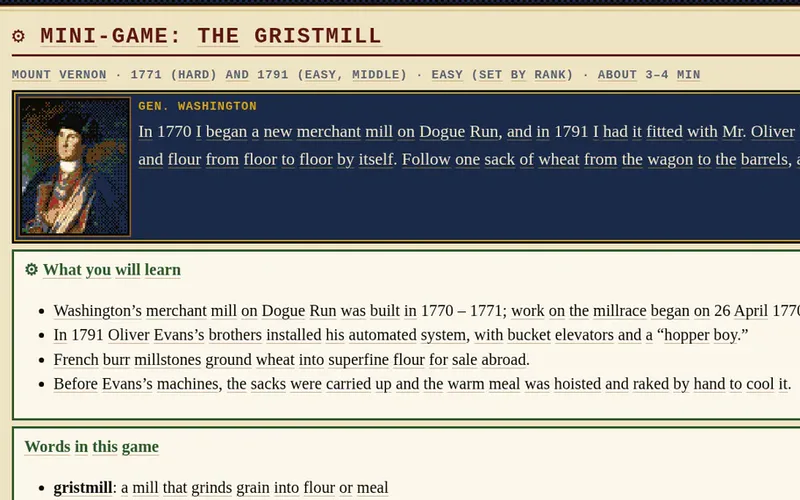
  • Mini-game card for The Gristmill, Mount Vernon, 1771 and 1791, on Evans's machinery.

    The Gristmill

    Mount Vernon

    What it teaches: putting steps in order, how a machine works

    The history: Washington's mill on Dogue Run made his top-grade "superfine" flour; in 1791 he fitted it with Oliver Evans's new self-running machinery.

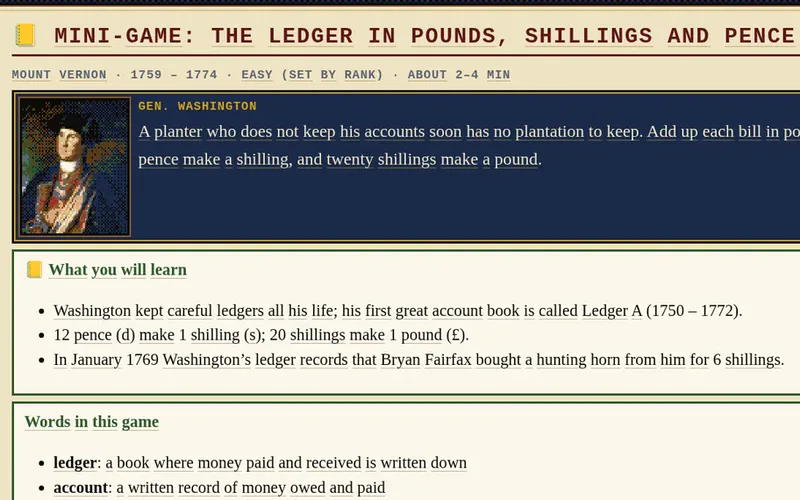
  • Mini-game card for The Ledger in Pounds, Shillings and Pence, Mount Vernon, 1759–1774: twelve pence to a shilling, twenty shillings to a pound.

    The Ledger

    Mount Vernon

    What it teaches: adding with carrying in base 12 and base 20 (12 pence make a shilling, 20 shillings a pound)

    The history: Washington kept careful account books all his life. One real entry records Bryan Fairfax buying a hunting horn from him for 6 shillings.

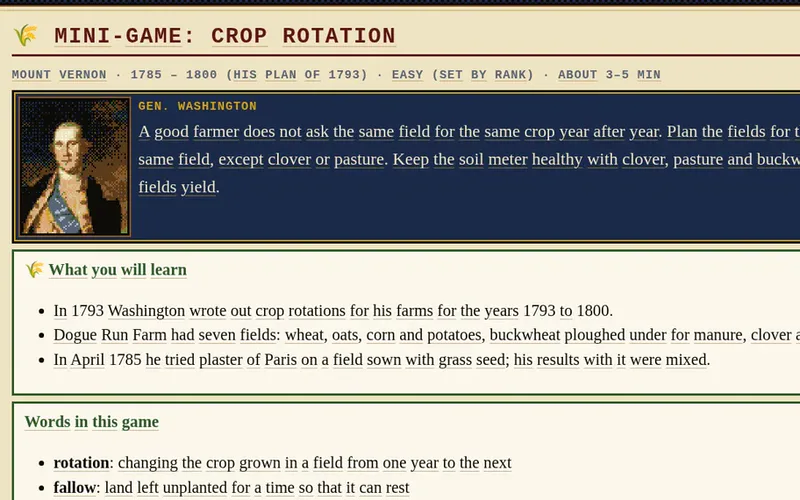
  • Mini-game card for Crop Rotation, Mount Vernon, 1785–1800, on Washington's 1793 field plan.

    Crop Rotation

    Mount Vernon

    What it teaches: planning on a grid, following a rule, soil science

    The history: In 1793 Washington wrote out a seven-year plan for rotating crops through the fields of Dogue Run Farm; the game shows his real plan at the end.

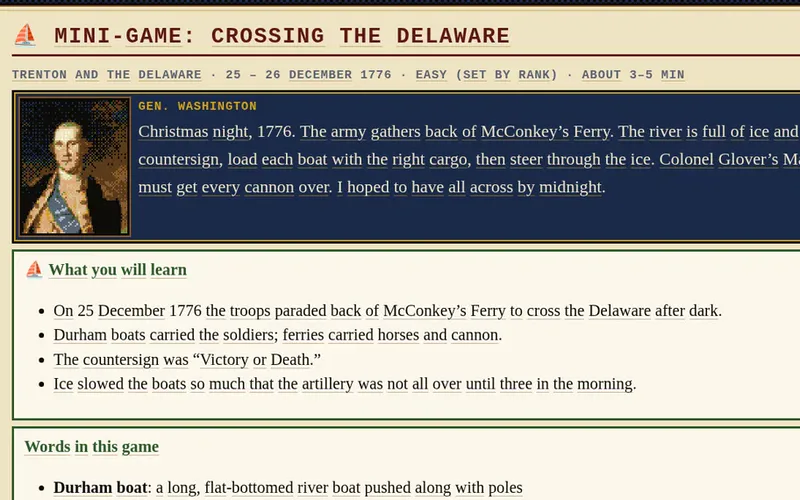
  • Mini-game card for Crossing the Delaware, 25–26 December 1776, at McConkey's Ferry.

    Crossing the Delaware

    Trenton

    What it teaches: sorting by size and weight, steering, keeping track of time

    The history: On Christmas night 1776, Glover's Marblehead sailors ferried the army through the ice. The password was "Victory or Death."

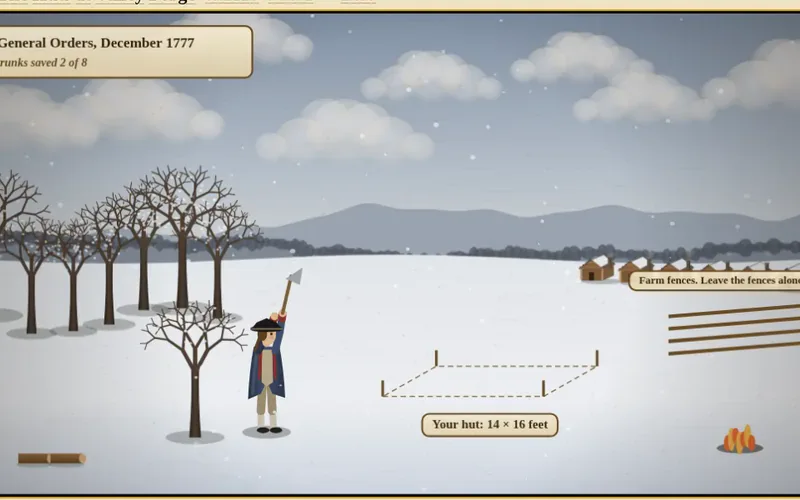
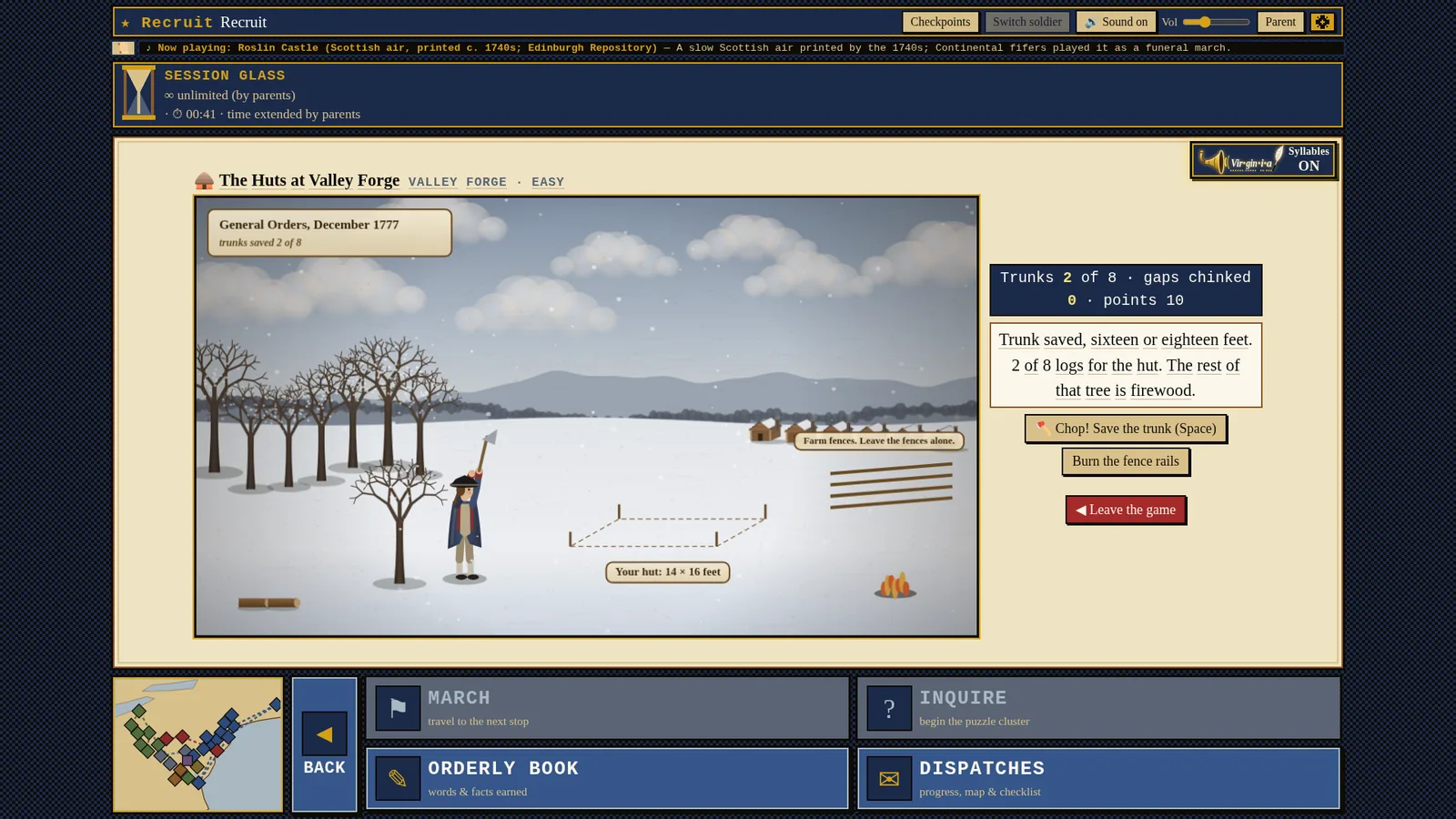
  • The Huts at Valley Forge, December 1777, the firewood step: trunks saved 2 of 8, the 14 by 16 foot outline in the snow, the fences left alone, and a small campfire.

    The Huts at Valley Forge

    Valley Forge

    What it teaches: following written orders, measuring, building in the right order

    The history: Built to Washington's real orders of December 1777: squads of twelve, huts 14 by 16 feet, gaps filled with clay, and a $12 prize for the best hut.

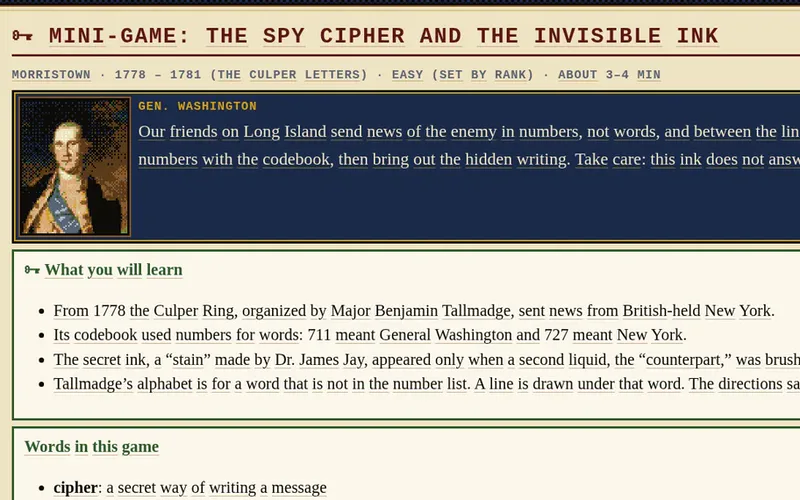
  • Mini-game card for The Spy Cipher and the Invisible Ink, Morristown, 1778–1781, on the Culper codebook and the stain.

    The Spy Cipher

    Morristown

    What it teaches: looking things up in a table, careful matching, testing an idea

    The history: Decode a letter from Washington's Culper spy ring with its real number codebook (711 meant General Washington), then reveal the invisible ink.

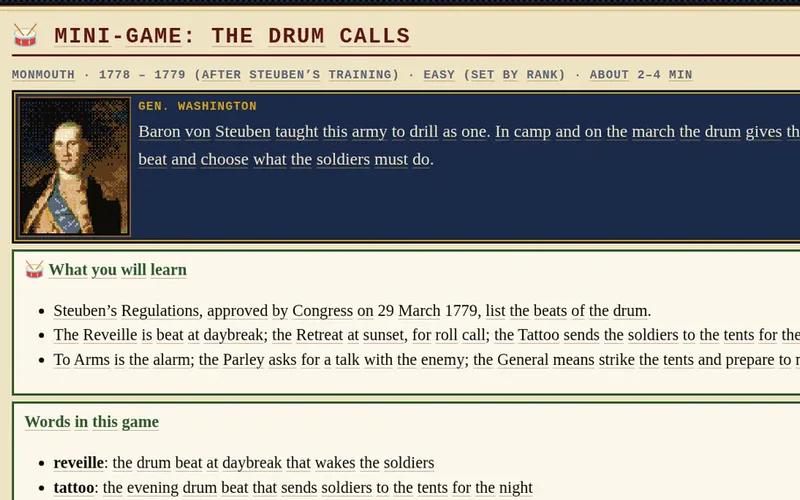
  • Mini-game card for The Drum Calls, Monmouth, 1778–1779, on Steuben's beats.

    The Drum Calls

    Monmouth

    What it teaches: careful listening, remembering patterns, matching a sound to its meaning

    The history: Baron von Steuben trained the army at Valley Forge; his drill book lists the drum calls that ran the soldiers' day, from Reveille to Tattoo.

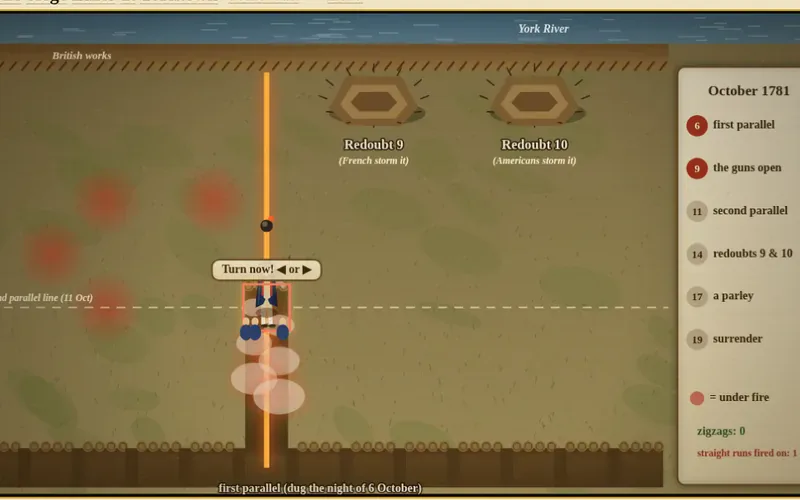
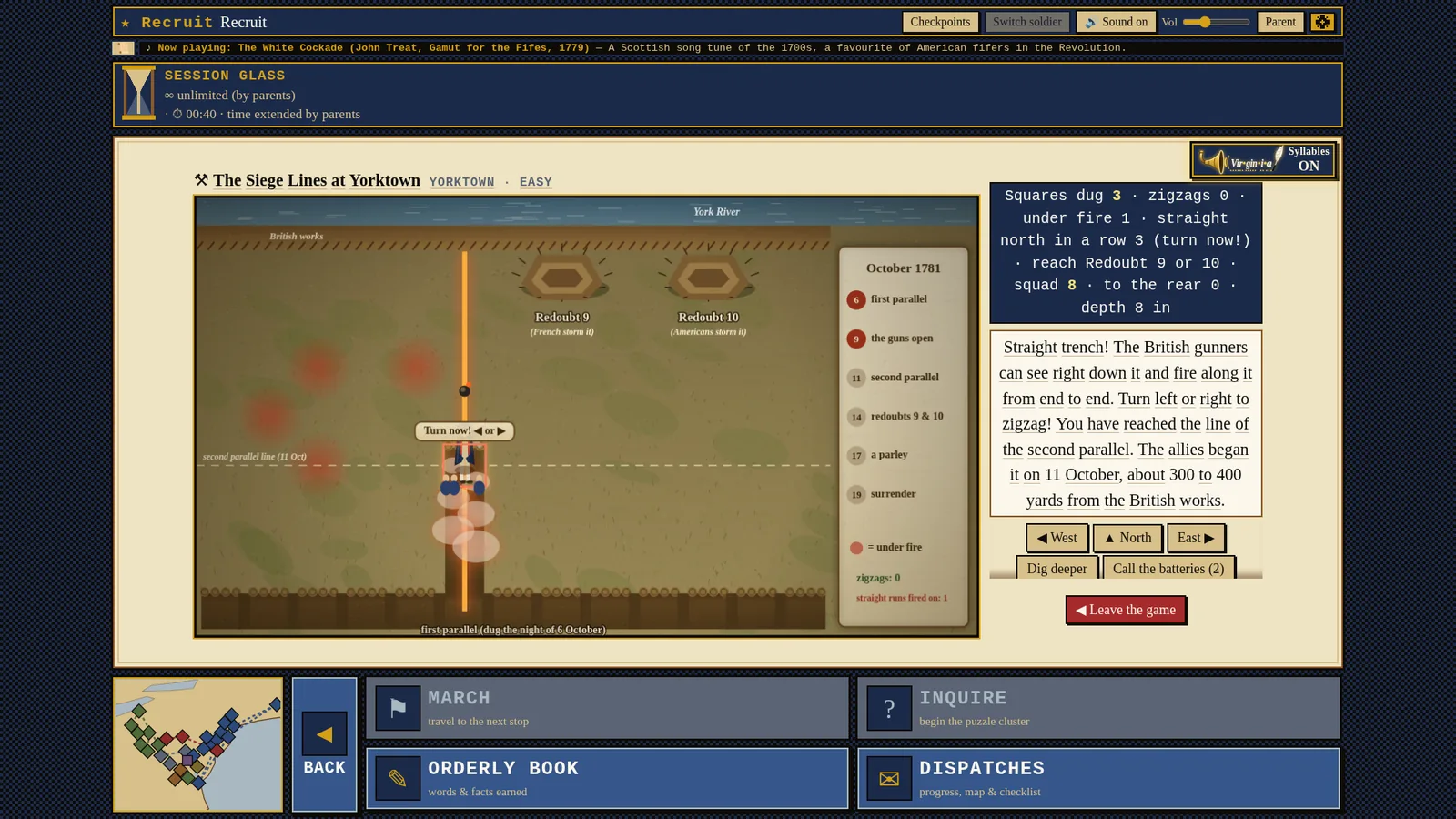
  • The Siege Lines at Yorktown, October 1781. A straight trench has reached the line of the second parallel and is under fire from the British works.

    The Siege Lines at Yorktown

    Yorktown

    What it teaches: planning a path on a grid, thinking ahead

    The history: Dig zig-zag trenches toward Redoubts 9 and 10, the way the American and French armies closed in before the British surrendered in October 1781.

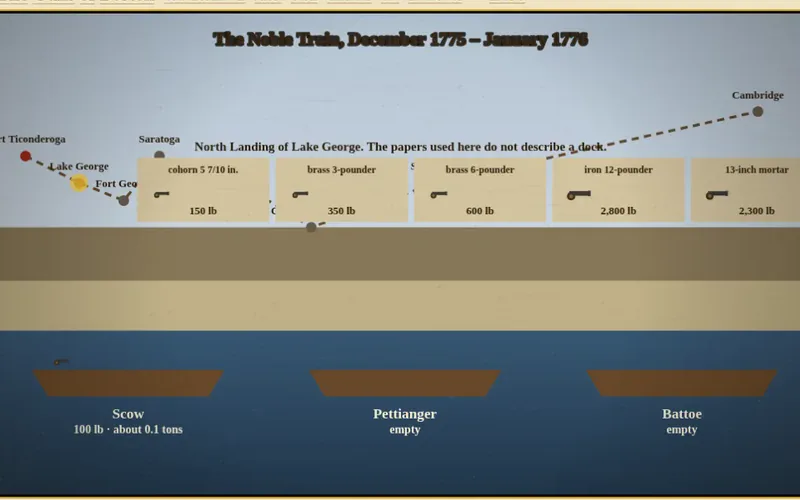
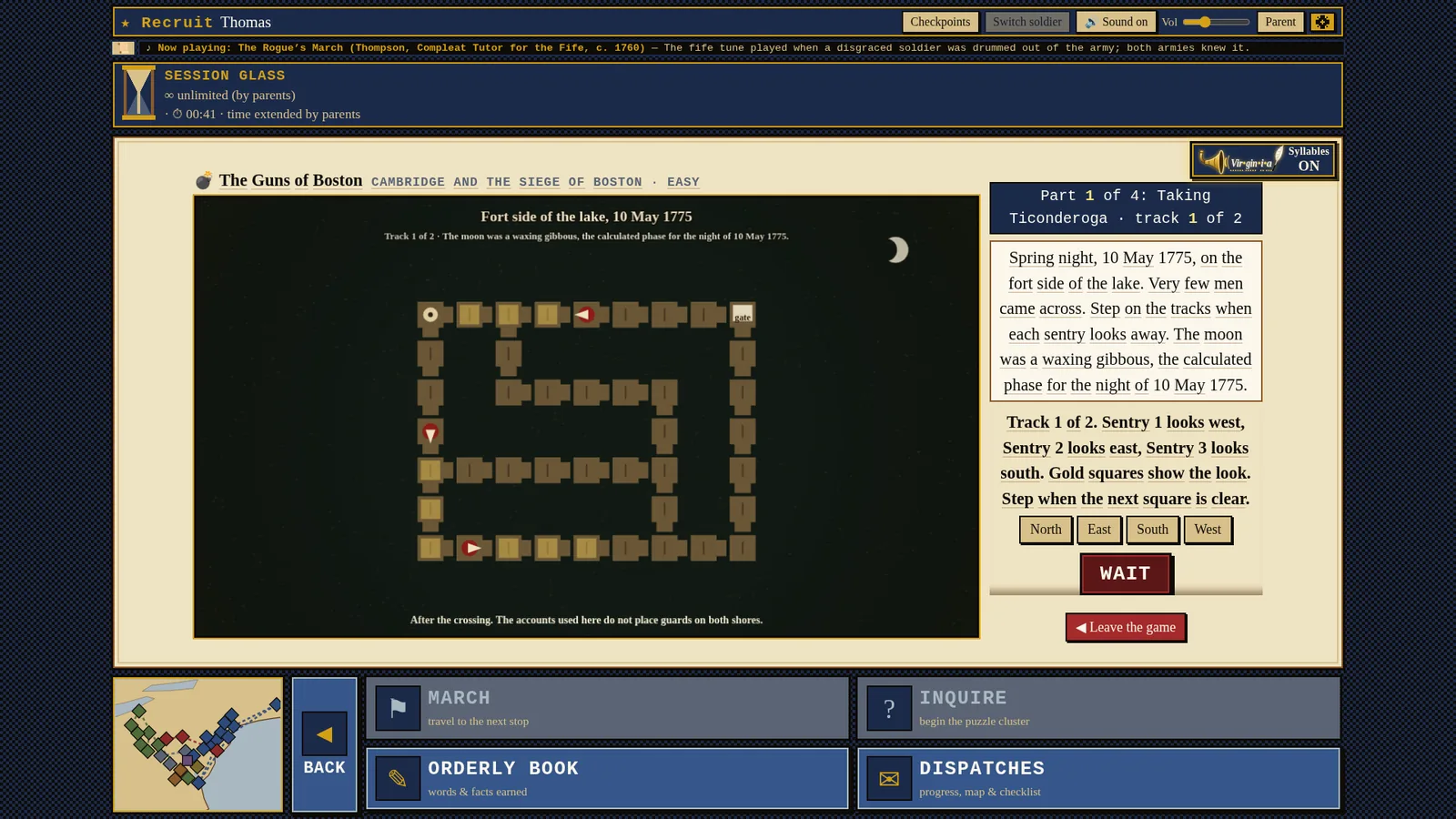
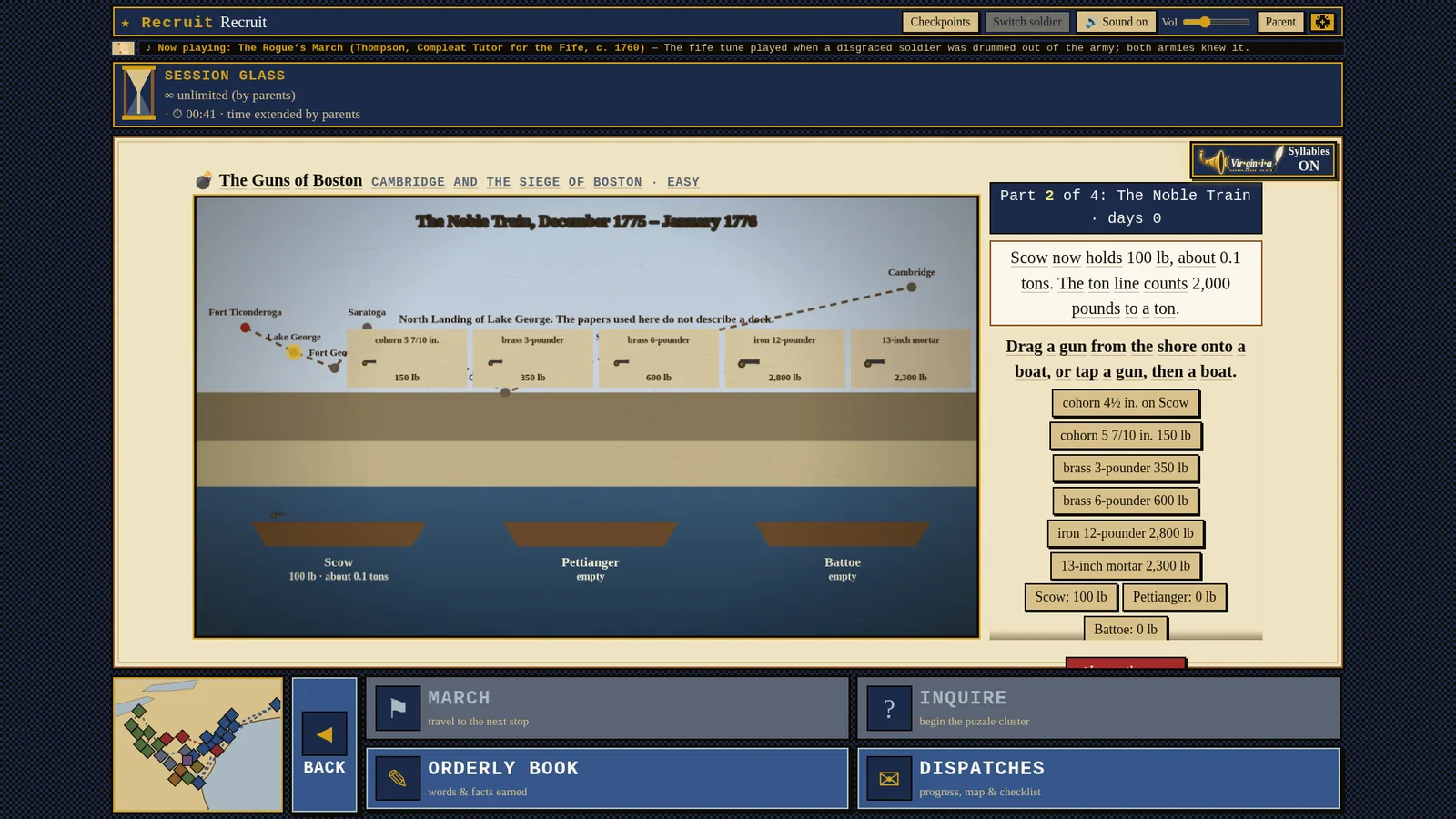
  • The Guns of Boston, part 2 of 4, The Noble Train, December 1775–January 1776. North landing of Lake George, with a cohorn on the scow.

    The Guns of Boston

    Cambridge and the Siege of Boston

    The King’s army is shut up in Boston, and we have too few great guns to drive it out.

For parents

You stay in charge. The game keeps to itself, and the history is told straight.

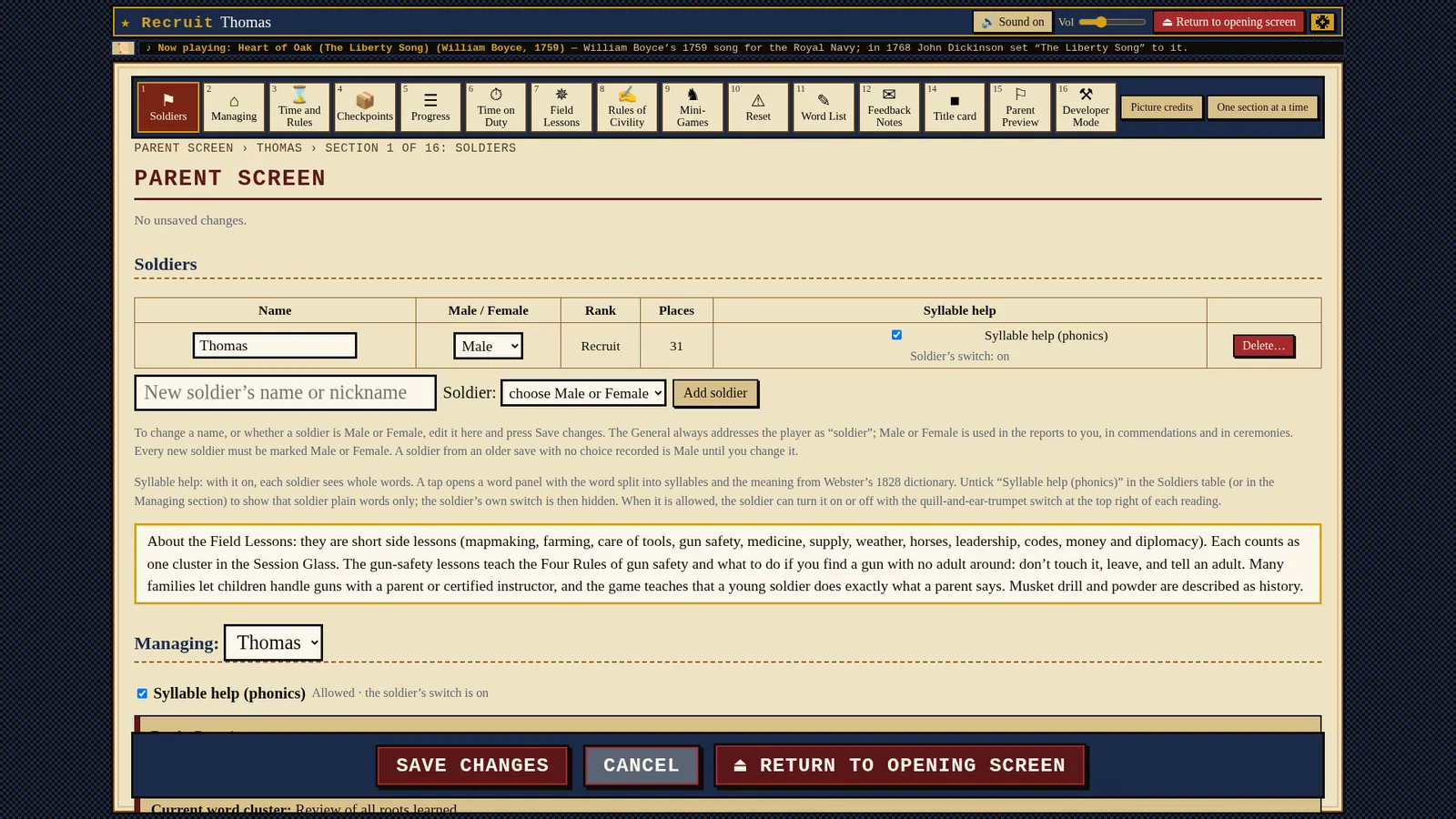
  • A parent screen. Set up a profile for each child, print report cards and a campaign guide, and adjust mini-game settings.
  • Phonics help your way. Turn syllable help on or off for each child.
  • Private by design. No ads, no accounts, and no data collected. Saves stay on your family's computer.
  • Works offline. It is a small app, about 9 MB on a Mac. No internet needed to play.
  • Honest history. Facts come from primary sources, including Washington's own journals and letters via Founders Online. They are told truthfully and at a level kids can handle.
  • Quiet when you want it. The fife music has a mute.

Read our privacy statement

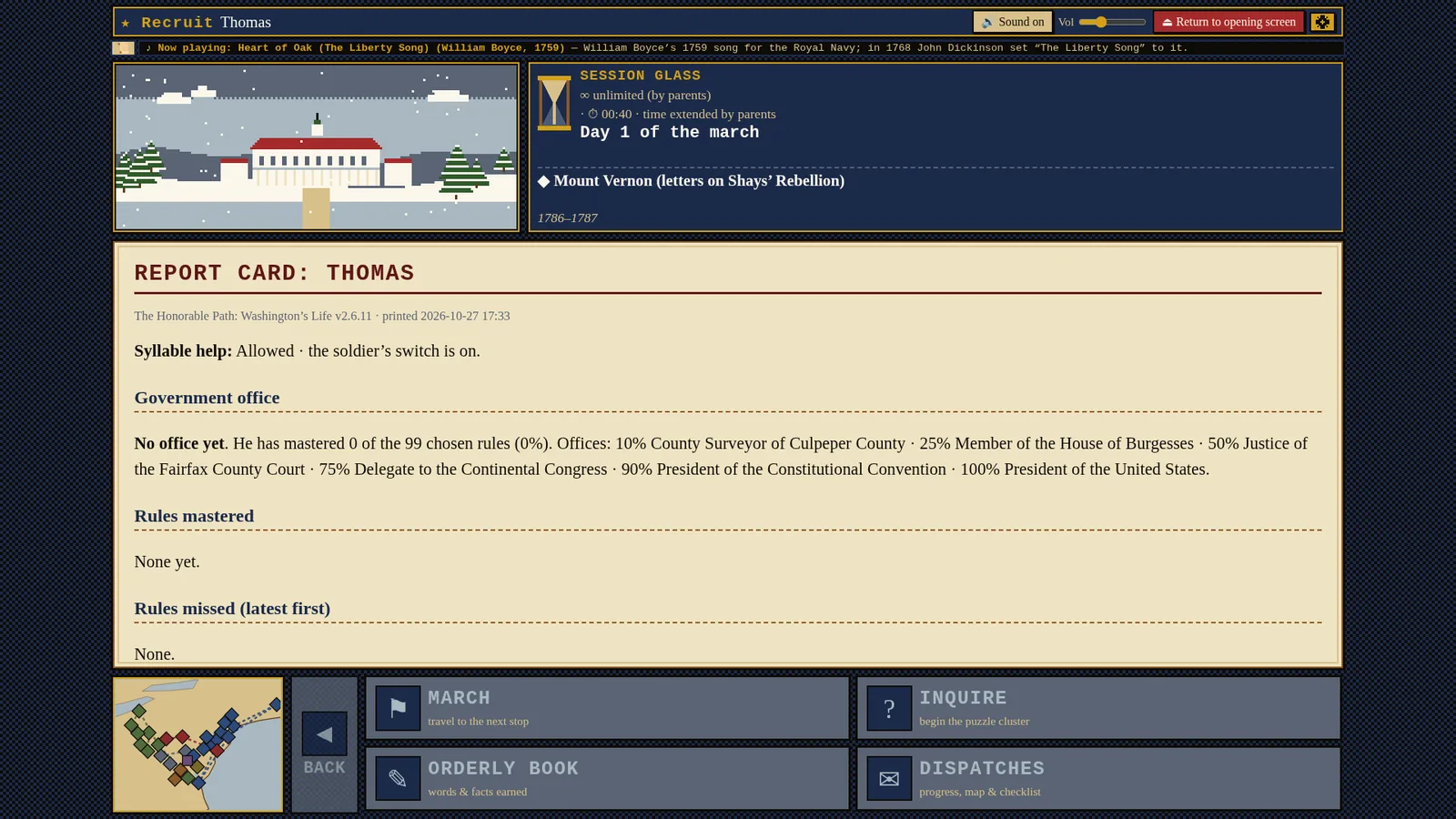
The Parent Screen, Soldiers section: one soldier, Thomas, rank Recruit, with syllable help allowed.
The Parent Screen: one row per child, with syllable help on or off.

Screenshots

Pictures from version 2.6.11 (October 2026). Select any picture to see it larger.

Platforms

The game is launching on four platforms. It is not available yet.

  • WindowsComing soon
  • MacComing soon
  • iPadComing soon
  • AndroidComing soon

Questions parents ask

What age is it for?

Kids 6 to 12. Younger readers will stretch, and that is the point: with a parent nearby and the optional syllable help switched on for them, they grow into it.

What does it cover?

Washington's life from boyhood through surveying, the 1751 voyage to Barbados, the French and Indian War and the Revolution. That is about 31 history readings, plus word roots, phonics help, primary sources, character, 15+ history mini-games, and fife-and-drum music from Washington's time.

Where do the facts come from?

From primary sources, mainly Washington's own journals and letters as published on Founders Online. Every reading has a ? box with the quoted passages and MLA citations, so you and your child can check them.

Does it need the internet?

No. It is an offline app, about 9 MB on a Mac.

Does it collect any data, show ads, or need an account?

No, no, and no. Saves stay on your family's computer. See the privacy statement.

Can I see how my child is doing?

Yes. The parent screen has a profile for each child, a printable report card, a printable campaign guide, and mini-game settings.

Can I turn off the music?

Yes. The music has a mute.

Found a glitch, or have an idea?

Please tell us on the feedback page. If the game shows you a feedback QR code, scan it with a phone: it opens that page with a few game details filled in, so we can find the problem faster. You can also email [email protected].

When can we get it, and what will it cost?

It is coming soon to Windows, Mac, iPad and Android. We have not announced a date or price yet. Follow along on Pinterest or Facebook for news.